
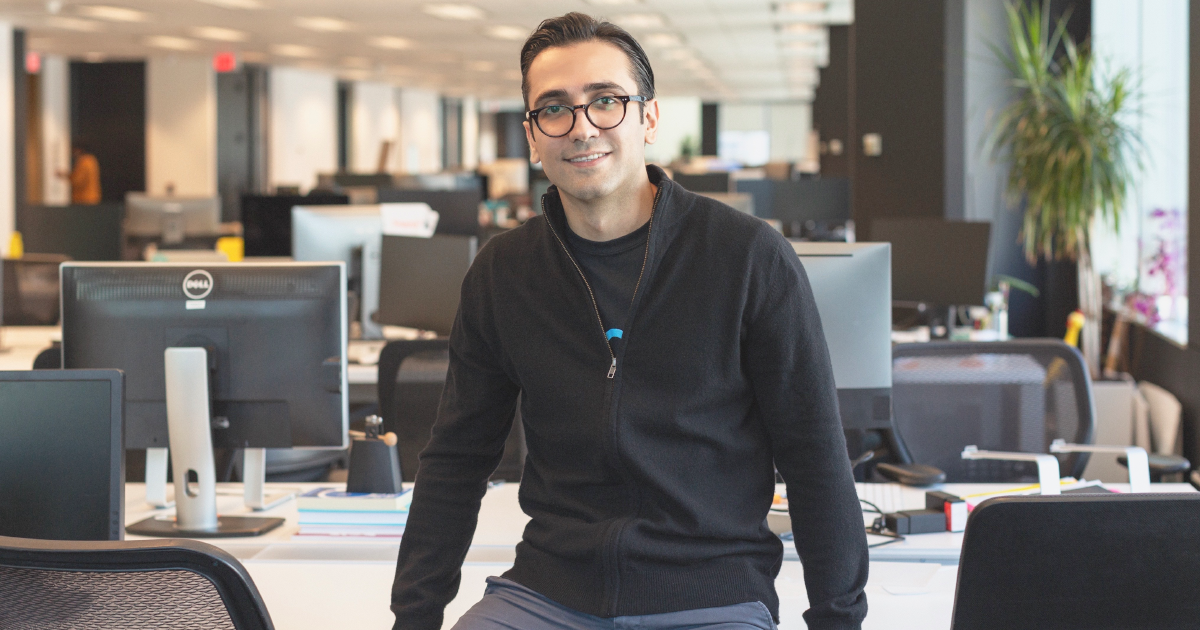
On some days, Dr. Khash Gharavi is chairside treating patients. On others, he’s working with developers and dental teams to solve one of the profession’s operational frustrations: insurance administration.
For Dr. Gharavi, the two roles are closely connected.
“I’m a clinician first,” he says. “But everything I’m building comes from problems I see in practice.”
That dual perspective is shaping how he views the future of dentistry—one that increasingly blends clinical care, business strategy, and technology. While many dentists still follow a traditional path from chairside practice into ownership, Dr. Gharavi is exploring new models for how modern practices can operate.
Starting with Structure
Dr. Gharavi began working with Dentalcorp as an associate in 2017. “It was one of my first clinics after graduating,” he recalls. “There’s a lot of support there, both technically and from a development standpoint.”
That experience helped him build confidence as a clinician while also exposing him to the operational side of dentistry—how practices run, how teams are managed, and how systems can improve efficiency.
Today, he divides his week deliberately: roughly two days seeing patients, with the remainder dedicated to Smilepass, an AI-powered dental insurance verification software built to automate insurance workflows and ease the administrative load on dental teams. The pain point is one every front-office team knows well, pulling a dental insurance breakdown traditionally means admin staff spending hours on the phone with providers. Smilepass delivers a more thorough breakdown in minutes, saving practices 20+ hours a week.
“Clinical work keeps me grounded in what dentists and patients actually deal with day to day,” he says. “The rest of the week, I'm working with our team at Smilepass on the problems that pull dentists away from patient care." “Insurance administration is one of the biggest hidden costs in a practice,” Dr. Gharavi explains. “If we can take that off the team's plate, we give front office staff something they can't get back any other way: time. Time to greet patients by name, answer questions without watching the clock, and build the kind of trust that turns a first visit into a lifelong relationship.”
Rethinking the Traditional Path
For decades, the expected trajectory in dentistry was relatively straightforward: gain clinical experience, purchase a practice, and transition into ownership. But that model is evolving, and Dr. Gharavi is part of a generation rethinking what success in the profession can look like.
His career path also reflects broader changes within dentistry, including the growth of corporate dentistry and increasing interest in alternative career models.
“There’s definitely more openness now to careers that look different,” he says. “You don’t have to choose between being a clinician and being an entrepreneur. A lot of us are doing both.”
Part of that shift is practical. The business side of dentistry—from staffing to operations and marketing—is complex and not typically covered in depth during dental school.
“Clinical training is strong,” he explains. “But business is something you have to learn on your own.”
Rather than rushing into ownership, Dr. Gharavi has chosen to develop those skills gradually while exploring opportunities beyond a single practice.
Thinking Beyond One Location
Ask Dr. Gharavi about the future, and the conversation quickly moves beyond his current clinical schedule.
“Smilepass already runs in practices in every province in Canada,” he says. “The next step is scaling from that base and entering the U.S. market.”
That growth is not just about geography. It also involves developing systems that can adapt across regulatory environments and practice sizes. Technology is central to that vision.
“We’re looking at ways to streamline processes and automate where possible,” he explains. “Especially for understaffed clinics. If you can make operations more efficient, you can help practices grow without putting additional pressure on cash flow.”
It’s a perspective that reflects a broader shift in dentistry, where clinical expertise increasingly overlaps with entrepreneurship and technology. For Dr. Gharavi, the two are not separate—they inform one another.
A Front-Row Seat to Industry Change
In addition to his clinical and entrepreneurial work, Dr. Gharavi participates in the CDSPI Advisory Panel, which brings together dental professionals to discuss industry trends and challenges. The group meets annually to provide feedback on emerging issues and help shape future products and services.
“It’s a chance to step back and look at the bigger picture,” he says. “What’s changing? What are the challenges? What do dentists actually need?”
Among the topics frequently discussed are government programs such as the Canadian Dental Care Plan (CDCP), reimbursement rates, and the financial sustainability of practices.
“These are real concerns,” Dr. Gharavi says. “They affect how practices operate day to day.”
The panel also provides an opportunity for connection and collaboration within the profession.
“Dentistry is a pretty tight-knit community,” he says. “These meetings are a good way to build relationships and hear different perspectives.”
Building a Network, One Connection at a Time
Despite his focus on growth and innovation, Dr. Gharavi remains grounded in one of the profession’s longstanding traditions: learning from peers.
“Study clubs are a big part of it,” he says. “And conferences—both the larger ones and smaller events.”
These settings provide opportunities to discuss cases, exchange ideas, and stay current with new developments in the profession. Increasingly, those conversations continue online.
“Social media has made it easier to stay connected,” he notes. “You can reach out to colleagues, get input on a case, or just stay in touch.”
Many of those relationships trace back to dental school—a reminder that the connections formed early in a career often become lasting sources of support and collaboration.
Looking Ahead
For Dr. Gharavi, the future of dentistry is full of possibility. Economic pressures, policy changes, and evolving patient expectations are continuing to reshape the profession.
Rather than viewing those shifts as obstacles, he approaches them as opportunities to better understand where dentistry is headed—and where he can contribute.
“There’s a lot changing,” he says. “But that also means there’s opportunity.”
For now, Dr. Gharavi continues to divide his time between patient care and growing Smilepass. The balance, he says, keeps him connected to both the realities of practice and the future he hopes to help shape.
More articles on Dr. Khash Gharavi: