

Part 1: Start with the right KPIs, then give each dollar a clear purpose.
A busy dental practice is not necessarily an efficient one. That was the inspiration for Stop the Financial Bleeding: Sealing the Hidden Inefficiencies in Your Practice Profitability, an expert panel discussion hosted by CDSPI at dental conferences across Canada this year. This two-part article draws on insights from the sessions held at the Pacific Dental Conference and the Ontario Dental Association’s Annual Spring Meeting.
Listen to what the practice is telling you
Revenue may be strong, the schedule may be full, and the practice may appear healthy on the surface. But if accounts receivable are lagging, staffing costs are drifting, credit is being used for the wrong purpose, or surplus cash has no defined role, the practice may be working harder than it needs to.
For owners, the goal is not to track every possible number or react to every fluctuation. It is to build a practical review rhythm around the signals that matter, so decisions about cash, credit, reinvestment and protection are based on what is actually happening in the practice.
One theme came through clearly during the panel sessions: the numbers only matter if they lead to better decisions. Jordan Weinberg, a partner at MNP, emphasized the importance of understanding which costs move the needle, rather than spending too much energy on smaller expense lines. Shane Dewling, an Investment Planning Advisor with CDSPI Advisory Services Inc., noted that owners are more likely to make efficient decisions when they are specific about what they want to accomplish, implement a plan, and monitor it over time.
Start with the practice owner's dashboard
Most practice owners already look at production. Many also keep a close eye on the bank account. Both matter, but neither tells the full story on its own.
A practice can show strong production while accounts receivable drift. It can have a full schedule while chair time is not being used efficiently. It can have rising revenue while overhead, staffing costs or debt payments are quietly absorbing the benefit. It can also have cash in the bank that feels reassuring but lacks a clear purpose.
A short, practical KPI dashboard can show where the practice is healthy, where money may be leaking, where decisions may be needed, and how often they should be reviewed.
Sample Owner's KPI dashboard
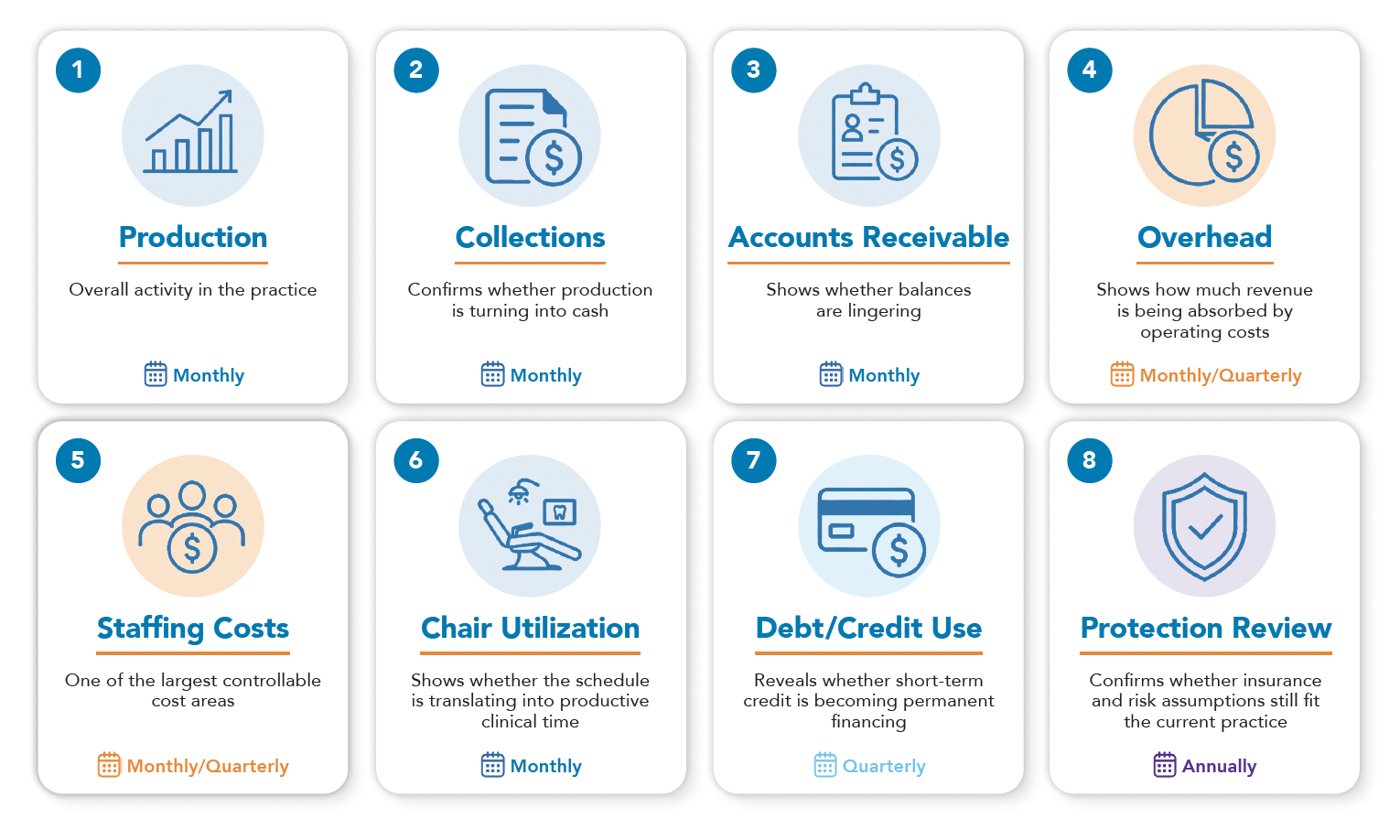
At the PDC session in Vancouver, the panel noted that practice health is rarely captured by one number alone. Gross revenue, overhead percentage, and cash flow all matter, but each can be misleading if viewed in isolation. The stronger approach is to look at how the numbers interact: whether production is turning into receivables, whether expenses are proportionate to revenue, whether debt is structured appropriately, and whether the practice is generating enough cash to support both business needs and owner goals.
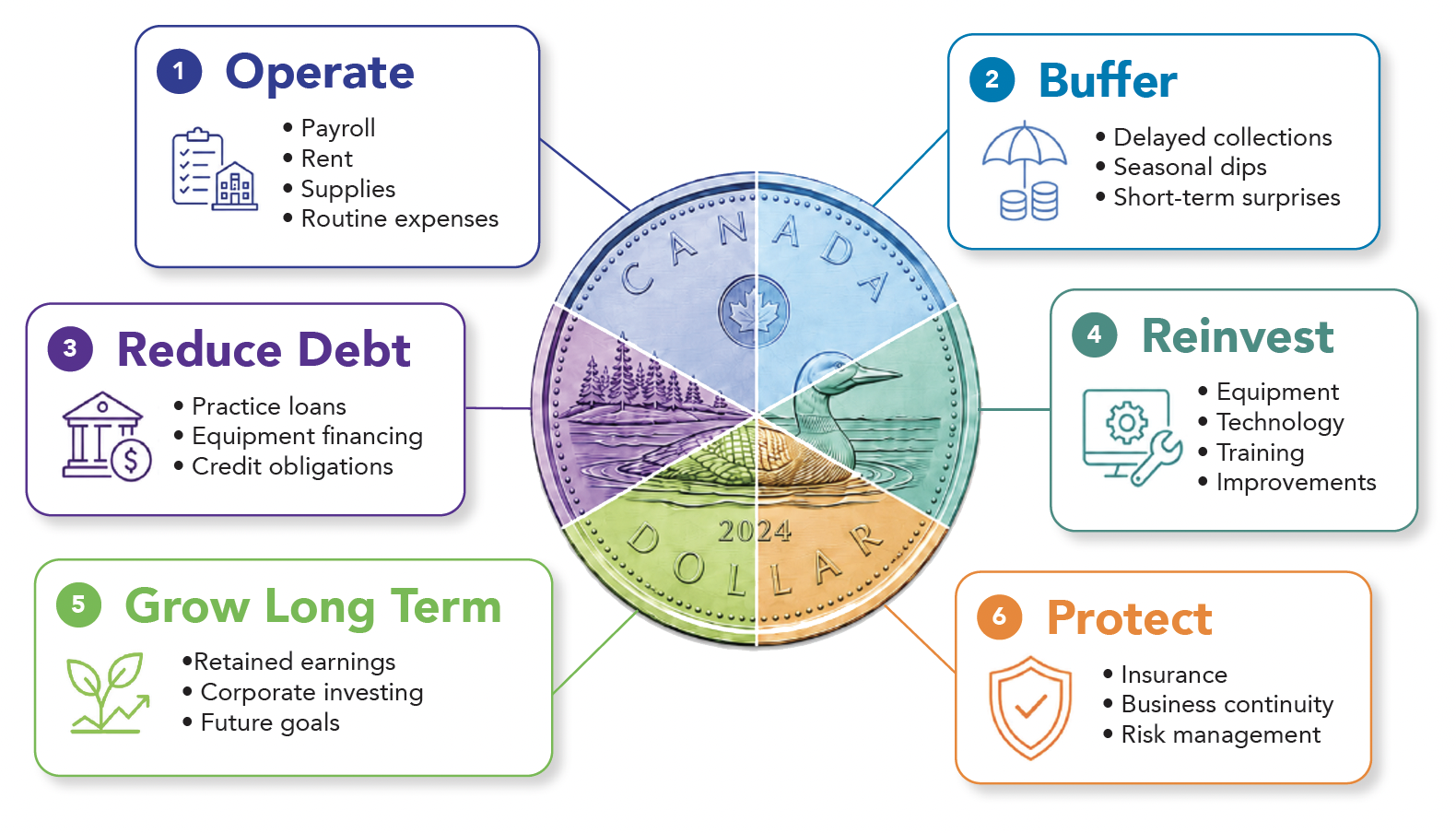
Give each dollar a job
Once owners have a clearer view of what is happening in the practice, the focus can turn to cash flow and what the dollars are doing for you.
Some dollars need to stay liquid because they support day-to-day operations. Some may be needed in the short term for taxes, payroll, debt payments, equipment, renovations or a temporary dip in production. Other funds may be better used to reduce debt. Longer-term considerations like corporate investing and protecting the business itself require money to be set aside well in advance.
Without that kind of clarity, cash can accumulate by default. It may feel safe sitting in the operating account, but it may not be helping the owner move toward a defined goal.
At the ODA session in Toronto, Shane Dewling, an Investment Planning Advisor with CDSPI Advisory Services Inc., suggested that owners are more likely to make efficient decisions when they are specific about what they want to accomplish, how they want to accomplish it and when they want to get there. The same principle applies to practice cash, as Shane put it: “Every dollar should have a purpose”.
The takeaway according to Shane is to “stop treating cash as one undifferentiated pool of money. When each dollar has a job, decisions about cash, credit, retained earnings, reinvestment and protection become easier to make.”
Cash is only surplus after the essentials are covered
Once each dollar is assigned a job, the next question is whether the practice is using the right tools for that job. Cash, credit, and retained earnings all have a role, but they are not interchangeable.
Cash supports stability. Credit can help manage timing or finance growth. Retained earnings may support longer-term planning. Problems often arise when one is being used to do the work of another.
A line of credit, for example, can be useful when there is a short-term gap between expenses and incoming cash. However, it may not be the right tool for a major equipment purchase, renovation, or other long-term asset. At the PDC session in Vancouver, Andrea Porter of Scotiabank noted that using operating credit for a large purchase can leave the practice short when payroll, supplies, or other day-to-day costs need to be covered.
“A line of credit is there for your day-to-day needs. If you use it for a major equipment purchase, you may not have room left when the practice needs operating cash.” - Andrea Porter, Scotiabank
That distinction matters because cash in the bank is not automatically “extra.” Before treating it as surplus, owners should account for operating costs, payroll, taxes, debt payments, planned purchases, upcoming renovations and reasonable reserves for disruption.
The same thinking applies when deciding whether to pay down debt, hold cash, or invest retained earnings. The right choice depends on the cost of borrowing, expected after-tax return, stage of growth, and the owner’s comfort with debt.
From an accounting perspective, Jordan Weinberg of MNP also cautioned that excess cash or passive assets inside the operating corporation may need attention before a future sale. Cash needed for day-to-day operations is one thing. Cash that has simply accumulated without a purpose may create tax or sale-readiness considerations that should be reviewed with an accountant.
For practice owners, the practical question is not simply “Do I have cash?” It is “What is this cash for, when will I need it and is it in the right place?”
“When a practice owner understands what the numbers are saying, cash decisions become more intentional. Operating reserves, credit, retained earnings and debt repayment become part of a larger plan for stability, flexibility, and long-term value. The next question is how to use those dollars wisely: when to reinvest, when to slow down before making a purchase, and how to protect the value the practice is building.
In the next article, we’ll look at how practice owners can reinvest with purpose and make sure their insurance coverage keeps pace as the practice changes. If you want to review your current situation with an advisor at CDSPI Advisory Services Inc., simply book a meeting at a time convenient to you.
Thank you to panelists Andrea Porter and Farzad Shafieian from Scotiabank, Shaun Howe and Jordan Weinberg from MNP, practicing dentists Dr. Soumya Jain and Dr. Sanjukta Mohanta, cybersecurity expert Anne Genge, and Brian Buris, Penelope Cenac, and Shane Dewling from CDSPI Advisory Services Inc. for helping shape a broader conversation about how practice owners can make more intentional decisions about performance, cash, credit, retained earnings, reinvestment and protection.
This information is provided for general information purposes only and is not intended as personal insurance, financial or legal advice. Speak with a licensed advisor for guidance specific to your situation.